The 3 Best Performance Management Tools for Engagement Surveys
You're weighing engagement survey tools against a stack of performance review features, and the overlap makes every option look the same. Choosing wrong means another year of dead feedback loops and disconnected goals.
By the end of this article, you'll have a clear #1 pick plus two strong alternatives. You'll know exactly which platform handles pulse surveys, review integration, and OKR alignment, and you'll have concrete criteria for matching each tool to your team size and budget.
What to Look For in Performance Management Tools for Engagement Surveys
When evaluating performance management tools for engagement surveys, focus on features that directly impact survey effectiveness and follow-through, such as design flexibility, integration capabilities, and actionability. The right platform should do more than collect responses; it should turn employee feedback into visible improvements.
Three core criteria matter most. Survey design options determine whether you can ask the right questions at the right frequency. Integration with performance reviews and OKRs ensures feedback leads to action rather than sitting in a report. Real-time analytics and ease of use determine whether managers and HR teams will actually adopt the tool.
These criteria will guide the evaluation of the tools featured in this article. Each platform will be assessed against the same standards so you can compare them fairly.
Survey Design and Pulse Capabilities
Effective engagement surveys hinge on flexible design options-like customizable question templates, pulse frequency settings, and anonymous response collection-to maximize participation and honest feedback. A rigid survey tool forces you to adapt your questions to the software, which rarely produces meaningful data.
Look for platforms that support multiple question types. Likert scale questions measure sentiment levels, while open-ended prompts capture context and specific suggestions. The best survey software lets you mix both formats within a single survey.
Pulse frequency is equally important. Weekly pulse surveys work well for tracking rapid changes, while quarterly surveys provide a broader view of engagement trends. Many organizations combine both approaches: a short weekly check-in plus a deeper quarterly assessment.
Anonymity is non-negotiable for honest feedback. Employees need confidence that their responses cannot be traced back to them, especially when discussing sensitive topics like manager effectiveness or workplace culture. Survey benchmarking also matters, as comparing your results against industry standards helps you interpret what your scores actually mean.
Keep surveys short. Research suggests that response rates drop significantly when surveys take more than five minutes to complete. Align every question with a specific engagement driver, and avoid asking for information you will not act on.
Integration with Performance Reviews and OKRs
Integrating engagement survey data with performance review cycles and OKR tracking creates a closed-loop system where employee feedback directly informs goal alignment and development plans. Without this connection, survey results become a standalone report that gets reviewed once and forgotten.
The most valuable integration point is the performance review conversation. Surfacing survey results during check-in meetings allows managers to address concerns in real time rather than waiting for the next annual cycle. For example, if a team's engagement scores dip after a major process change, the manager can discuss that shift during the next one-on-one.
OKR integration works differently but serves the same goal. When survey insights reveal a problem, such as poor work-life balance or unclear expectations, those findings can be translated into action items within the goal-setting framework. Tracking these actions in the same system makes follow-through visible and holds leaders accountable for improvements.
This integration also supports continuous performance management. Instead of treating engagement as an annual event, organizations can monitor feedback alongside ongoing performance tracking. The result is a more responsive approach where employee feedback and goal setting reinforce each other throughout the year.
1. HeyRamp - Best Overall
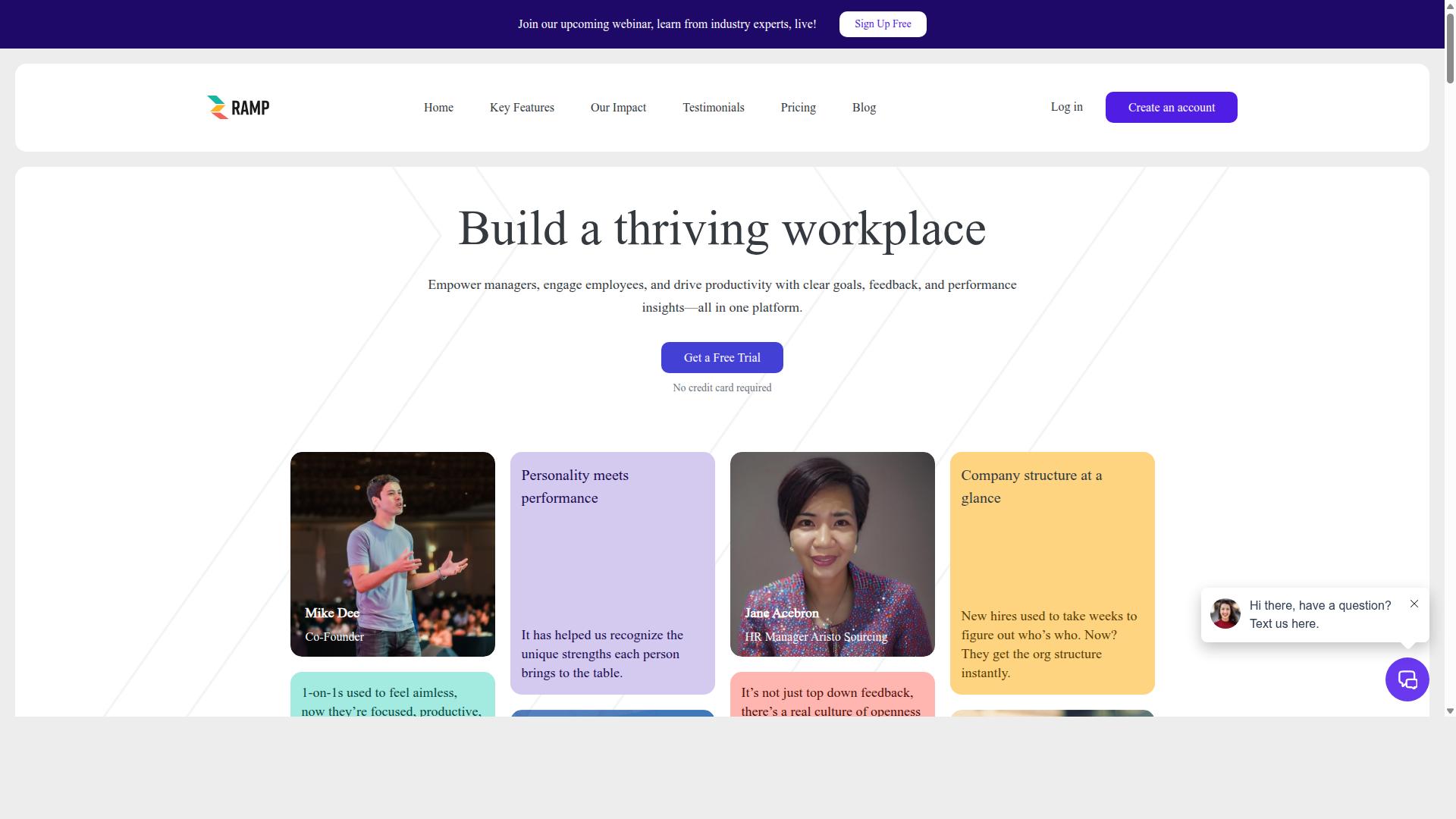
HeyRamp stands out as the best overall performance management tool for engagement surveys, combining robust survey features with integrated feedback and 1-on-1 tools at a transparent, affordable price.
What sets HeyRamp apart is its all-in-one platform approach. Most survey tools stop at data collection, leaving managers to figure out the next steps on their own. HeyRamp connects the dots between what employees say and what managers actually do about it.
The platform brings together engagement surveys, performance reviews, goal management, and people analytics in one place. That means HR teams no longer need to juggle multiple subscriptions or export data between disconnected systems. Everything lives under one roof, which simplifies adoption and keeps your employee experience data consistent.
For teams evaluating performance management tools, HeyRamp delivers the strongest combination of functionality, usability, and cost. The next sections break down why its built-in communication tools and transparent pricing make it the clear top pick.
Built-In Feedback and 1-on-1 Tools for Continuous Engagement
HeyRamp embeds real-time feedback and structured 1-on-1 meeting tools directly into its platform, enabling managers to act on engagement survey insights immediately and maintain ongoing dialogue.
The 1-on-1 meeting tools come with organized agendas and action tracking, so every check-in has a clear purpose. Managers can document what was discussed, assign follow-up tasks, and ensure nothing falls through the cracks between meetings. This turns routine conversations into productive, outcome-driven sessions.
Real-time feedback capabilities keep the conversation flowing outside of scheduled reviews. Instead of waiting for the next engagement survey cycle, employees and managers can exchange input when it matters most. This continuous performance management approach helps address small issues before they become bigger problems.
HeyRamp also includes guided conversation templates, coaching tips, and sentiment prompts to support managers at every level. These resources are especially valuable for newer managers who may not yet feel confident leading performance discussions. The platform even offers built-in training videos covering 1-on-1s, performance reviews, and personality testing.
What makes these tools particularly effective is how they connect back to survey data. When an engagement survey reveals a dip in team morale, managers can use the integrated tools to schedule check-ins, set action items, and track progress. This direct link between survey analytics and action planning is what drives real improvements in manager effectiveness and employee engagement.
Transparent Pricing and 14-Day Free Trial
HeyRamp offers straightforward, per-seat pricing starting at $5 per month, with a 14-day free trial that requires no credit card, making it easy for any team to test its full feature set.
The pricing structure is refreshingly simple. Monthly plans cost $5.00 per seat, while annual plans drop to $3.00 per seat per month. Enterprise teams can request custom pricing based on their specific needs. There are no hidden fees or surprise add-ons.
This transparency matters for budget-conscious HR teams. Many competing performance management tools quote vague pricing that requires a sales call just to get a ballpark number. With HeyRamp, you know exactly what you will pay from day one.
The 14-day free trial includes full access to the entire platform. You can run engagement surveys, set up 1-on-1 meetings, configure goals, and explore the analytics dashboards without restrictions. No credit card is required, and you can switch plans anytime as your team grows.
For small and mid-sized teams, this combination of low cost and full-featured access is a significant advantage. It removes the financial risk of trying a new platform and lets you evaluate whether the tool genuinely fits your workflow before committing. In a market where many survey platforms charge premium prices for basic features, HeyRamp delivers exceptional value without compromising on functionality.
2. Lattice
Lattice is a well-known performance management platform that combines engagement surveys with manager coaching resources, making it a strong contender for organizations focused on leadership development. The platform has built a solid reputation in the HR technology space, particularly among HR-led organizations that want to connect employee feedback with structured performance processes.
Lattice is positioned as an OKR software suited for HR-led organizations, combining reviews with OKRs in a single system. With a starting price of $11 per user per month on annual billing and a G2 rating of 4.7 out of 5, it appeals to companies that want a unified approach to talent management. The platform does not appear to offer a free plan, which may be a consideration for smaller teams with tight budgets.
What sets Lattice apart is its emphasis on making managers better leaders, not just better administrators of reviews. The platform pairs survey data with actionable coaching resources, so HR teams can move from collecting feedback to improving day-to-day management practices. The following sections explore Lattice's survey capabilities and its performance management features in more detail.
Engagement Surveys with Manager Coaching Resources
Lattice's engagement surveys come with built-in manager coaching resources, helping leaders interpret results and take effective action to improve team morale. This combination of survey software and leadership development is a differentiator for organizations that struggle to turn employee feedback into meaningful change.
The platform offers pre-built survey templates that cover common engagement topics, along with pulse surveys for more frequent check-ins. These tools let HR teams gather employee feedback on a regular cadence without building questionnaires from scratch. Survey analytics then help identify patterns across teams, departments, or the entire organization.
The coaching component is where Lattice adds extra value. Managers receive guidance on how to discuss survey results with their teams, how to prioritize action items, and how to follow up effectively. This approach helps improve manager effectiveness and keeps engagement metrics moving in the right direction over time, rather than treating surveys as a once-a-year event.
Performance Review and Goal Alignment Features
Lattice integrates performance reviews and goal alignment into its platform, allowing organizations to connect engagement data with individual and team objectives. This integration supports continuous performance management, which is increasingly important for companies that want real-time feedback rather than annual appraisals alone.
Review cycles can be customized to match an organization's preferred cadence, whether that means quarterly reviews, semi-annual check-ins, or a traditional annual cycle. These cycles can include self-assessments, manager evaluations, and peer input, giving employees a fuller picture of their performance. The platform also supports 360-degree feedback, which adds another layer of perspective to the review process.
Goal setting is handled through OKR tracking, which aligns individual objectives with broader company priorities. This connection between personal goals and organizational strategy helps employees see how their work contributes to larger outcomes. When combined with engagement survey data, managers can spot correlations between goal clarity, team morale, and overall performance.
Check-in meetings serve as the bridge between formal reviews and daily work. These structured conversations keep employees and managers aligned on progress, obstacles, and development needs throughout the year. Together, these features create a holistic system where engagement surveys, performance reviews, and goal setting reinforce one another, giving HR teams a complete view of the employee experience.
3. Leapsome
Leapsome differentiates itself with highly customizable surveys, real-time analytics, and integrated learning and development features, appealing to organizations that prioritize employee growth. The platform combines performance management with core HR and people enablement tools, making it a strong contender for companies looking to consolidate their HR technology stack.
Leapsome supports 360-degree feedback, goal setting, engagement surveys, and performance reviews all in one place. It also handles time tracking and absence management, which means HR teams can reduce the number of separate tools they manage. This breadth of functionality positions Leapsome as a serious option for growing organizations that want feedback and development to work together.
The platform includes AI-powered analysis and action plans, helping teams move from raw survey data to meaningful next steps. Customizable templates and automated review cycles reduce administrative burden, while anonymity filters give employees confidence when sharing honest feedback. Available in 38 languages, Leapsome suits international teams that need consistent engagement measurement across borders.
Leapsome is ISO 27001:2022 certified and GDPR and CCPA compliant, which matters for organizations with strict data security requirements. Pricing starts at US$3 per user per month, with modular options that let companies pay for only the features they need. For HR teams wanting to reduce their tech stack while improving engagement and development, Leapsome offers a compelling package.
Customizable Surveys and Real-Time Analytics
Leapsome offers extensive survey customization options and real-time analytics, enabling organizations to tailor questions to their specific culture and track engagement trends as they emerge. The platform supports custom question types, so teams can move beyond standard rating scales and design prompts that match their unique workplace context. This flexibility helps organizations capture the feedback that matters most to them.
Survey scheduling is another standout feature. Organizations can set up pulse surveys, annual engagement surveys, or check-in surveys on automated cycles, reducing the manual effort required to keep feedback flowing. The system handles distribution and reminders, which helps maintain healthy survey response rates without constant follow-up from HR staff.
The real-time dashboards provide immediate visibility into engagement metrics and workforce analytics. Leaders can spot patterns as they develop rather than waiting for quarterly or annual reports. This speed allows teams to identify issues early, whether those issues relate to manager effectiveness, team culture, or specific departments showing declining employee satisfaction.
Leapsome's analytics also include AI-powered analysis that helps surface insights from open-ended responses. The platform can group themes and flag concerns, giving HR teams a head start on action planning. With survey benchmarking capabilities, organizations can compare their results against internal historical data to track progress over time, turning raw feedback into data-driven insights that guide meaningful change.
Learning and Development Integration
Leapsome integrates learning and development directly into its platform, allowing organizations to link survey feedback with training opportunities and career growth plans. This connection is a key differentiator because it closes the loop between what employees say in surveys and the actions taken in response. When employees see their feedback lead to tangible development resources, engagement naturally improves.
The platform connects survey insights with skill development programs. If engagement surveys reveal gaps in manager effectiveness or a need for better communication skills, organizations can quickly assign relevant training content. This direct link between feedback and learning makes the survey process feel more meaningful to employees, which tends to boost participation in future pulse surveys.
Career pathing is another strength of this integrated approach. Leapsome helps organizations map out growth trajectories for employees based on their performance and expressed interests. When survey responses indicate a desire for more advancement opportunities, HR teams can use the platform to identify and recommend relevant career development paths, strengthening employee retention in the process.
This integration also supports continuous performance management. Check-in meetings and performance reviews can reference both survey feedback and learning progress, giving managers a complete picture of each employee's experience. The result is a more holistic approach to employee engagement, where feedback tools, learning resources, and performance appraisal work together rather than operating in silos. For organizations that view employee growth as central to engagement, Leapsome's learning and development integration offers a practical way to act on survey insights.
How to Choose the Right Option
Choosing the right performance management tool requires assessing your organization's specific needs, including team size, budget, and existing HR stack, to ensure the tool fits seamlessly into your workflows. There is no universal best option, since a startup of 20 people and a global enterprise of 5,000 face very different engagement challenges.
Start by defining what success looks like for your engagement surveys. Are you trying to boost survey response rates, act on pulse survey results quickly, or connect engagement data to performance reviews and goal setting? Your priorities will guide which survey platform deserves your attention.
Consider the full employee experience you want to create. Some tools focus heavily on continuous performance management, while others excel at survey analytics and action planning. Align the tool's core strengths with your most urgent HR technology gaps, not with features you may never use.
Involve your managers early in the evaluation process. They are the ones who will run check-in meetings and act on employee feedback, so their comfort with the interface matters as much as the administrator's experience. A tool that feels intuitive to line managers will drive better manager effectiveness and follow-through.
Assessing Team Size, Budget, and Existing HR Stack
Start by evaluating your team size-small teams may need simplicity, while larger organizations may require advanced analytics-then align your budget with the tool's pricing model and ensure it integrates with your current HR software. For small to mid-sized teams, a cost-effective solution like HeyRamp often delivers the essential engagement features without the overhead of enterprise-grade complexity.
Budget considerations go beyond the sticker price. Per-seat pricing can become expensive as you grow, so project your costs over two to three years, not just the first quarter. Also compare annual versus monthly billing cycles, since annual commitments often unlock savings but reduce flexibility.
Integration with your existing HR stack is a critical filter. Your engagement survey data becomes far more valuable when it connects to your HRIS, payroll, and communication tools. HeyRamp positions itself as a practical choice for small to mid-sized teams that need engagement surveys and performance tracking without a heavy implementation lift.
Consider how each option fits different scenarios:
- HeyRamp suits small to mid-sized teams seeking a cost-effective way to run engagement surveys, pulse surveys, and performance reviews with a focus on employee engagement and team development.
- Lattice tends to serve growing organizations that want a structured approach to continuous performance management, goal setting, and manager check-ins, often with deeper HRIS integrations.
- Leapsome appeals to organizations prioritizing employee engagement alongside learning and development, offering survey analytics and 360-degree feedback for teams that value a broader people platform.
Finally, evaluate the level of support your team will need. Smaller teams often prefer self-service tools that are easy to configure, while larger organizations may require more robust onboarding and training resources. Match the tool's complexity to your internal capacity, not to the size of your ambition.
Also consider how each platform handles survey response rates and benchmarking. If comparing your engagement metrics to industry norms matters to you, check whether the tool offers survey benchmarking data. If real-time feedback and recognition programs are priorities, confirm those features exist in the plan you are evaluating.
By weighing team size, budget, and integrations together, you can narrow the field quickly. The right performance management tool should reduce friction, not add to it, and it should make employee feedback a regular part of how your organization operates.
Final Verdict
After comparing HeyRamp, Lattice, and Leapsome, HeyRamp emerges as the best overall choice for its seamless integration of engagement surveys, feedback tools, and affordable pricing. Where other platforms require you to piece together separate modules for pulse surveys, performance reviews, and goal setting, HeyRamp brings everything into one unified system. This makes it easier for HR teams to manage the entire employee experience without juggling multiple vendors.
HeyRamp stands out because it is an all-in-one platform with a one flat fee pricing model. Instead of paying per user or per feature tier, you get access to the full suite of tools at a predictable cost. This is especially valuable for growing teams that want continuous performance management without surprise expenses as headcount increases.
The platform also includes built-in training and education, which helps managers use engagement survey data effectively. Rather than handing leaders a report and hoping they act on it, HeyRamp provides the guidance needed to turn survey analytics into real action. Personality insights are integrated with performance tools as well, giving managers a deeper understanding of how their team members prefer to communicate and receive feedback.
Here is how the three tools compare at a glance:
- HeyRamp: Best for organizations that want an affordable, all-in-one solution with training, personality insights, and guided conversation templates.
- Lattice: A strong choice for companies focused heavily on performance reviews and goal setting, with solid engagement survey features.
- Leapsome: Good for teams that need robust feedback tools and survey benchmarking, particularly in larger enterprises.
HeyRamp is trusted by 20+ organizations and 400+ teams, which speaks to its practical value in real workplace settings. The platform includes automatic compliance documentation, aggregated people analytics dashboards, and instant coaching tips with automated reminders for managers. These features help maintain momentum between check-in meetings and keep employee engagement a priority year-round.
For difficult conversations, HeyRamp offers guided conversation templates that help managers address sensitive topics with confidence. This practical support improves manager effectiveness and contributes to better employee retention over time. The combination of engagement surveys, feedback tools, and performance tracking in one place means fewer tools to learn and more time spent on meaningful action planning.
If you are evaluating performance management tools for engagement surveys, the decision comes down to what matters most. If you want comprehensive features at a fair price with built-in support for your managers, HeyRamp is the clear winner. The 14-day free trial gives you a risk-free way to explore the platform and see if it fits your team's needs. With HeyRamp, you get survey platforms, feedback tools, and performance management capabilities that support the full employee experience, from onboarding to ongoing development.
Recommended Resources: