Team Building Workshops That Change How Teams Work: What to Look For
Your team building day ends with everyone laughing, and by Monday nothing has changed. That gap between a fun afternoon and a different Monday morning is the whole problem. You are about to spend budget and a full workday, so the format has to earn both.
This article breaks down what OptimizeTeamwork offers and how to judge whether its workshops actually shift how a team communicates and collaborates. You will learn what real change looks like in a well-designed session, which features to compare, and how pricing, credentials, and track record factor into the decision.
What Is OptimizeTeamwork?
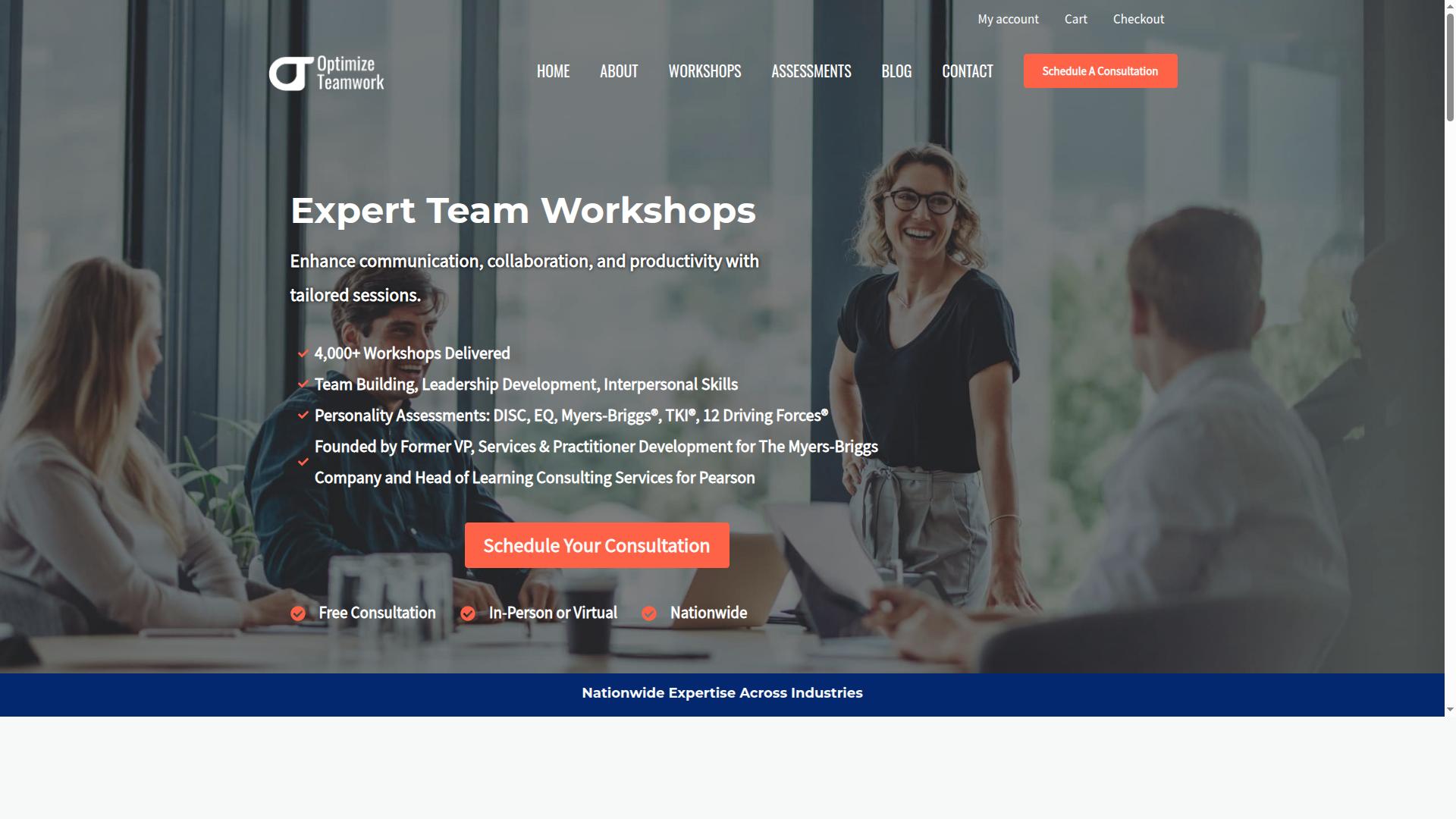
OptimizeTeamwork is a professional development and team training consultancy founded by Dr. Rachel Cubas-Wilkinson that specializes in expert-led workshops designed to enhance communication, collaboration, and team effectiveness. It is a people-focused service, not a software platform.
That distinction matters, because the name is sometimes confused with Teamwork.com, the project management software company. OptimizeTeamwork is not affiliated with Teamwork.com in any way. One is a consultancy that develops leaders and teams in person and online; the other sells project management software.
At its core, the firm focuses on three connected areas: team building workshops, leadership development, and personality-informed training. Sessions can be delivered with or without a personality assessment, depending on what a team needs.
Its track record is substantial. OptimizeTeamwork has delivered over 4,000 workshops and trained 30,000+ leaders, giving it deep experience across many kinds of teams and workplaces.
The consultancy draws on established assessment tools, including DiSC, MBTI, EQ, and TKI. These instruments help teams understand working styles, emotional intelligence, and how people handle conflict, which makes the training practical rather than abstract.
Delivery is nationwide, both in person and virtually, so distributed and hybrid teams can take part without gathering in one place. Offerings range from teamwork optimization and leadership development to transforming workplace culture, enhancing interpersonal skills, and using personality in sales.
For anyone weighing team development programs, this is the key takeaway: OptimizeTeamwork is a legitimate, established training consultancy with a clear specialty and a long delivery history. It is not a tool to install, but a partner to bring into the room.
Do OptimizeTeamwork's Team Building Workshops Actually Change How Teams Work?
The effectiveness of any team building workshop hinges on whether it produces lasting behavioral change-not just a temporary morale boost. That is the core question worth asking before booking any team development program, and it applies just as much to OptimizeTeamwork's offerings as to any other provider.
The honest answer is that workshops can drive real change, but only when they are built around the right mechanisms. A day of games and icebreakers might lift spirits for a week. A facilitated workshop that surfaces real friction, connects it to daily behavior, and ends with concrete commitments can shift how a team operates for months.
Well-designed workshops combine three elements: experiential learning, structured reflection, and action planning. Remove any one of those and the workshop tends to fade quickly once everyone returns to their desks. Keep all three and the effects show up in meetings, handoffs, and conflict conversations.
The rest of this section explains what genuine change looks like, so you can judge any workshop, including OptimizeTeamwork's, on evidence rather than enthusiasm.
What "Change" Looks Like in a Well-Designed Workshop
In a well-designed workshop, change is evidenced by specific shifts in group dynamics-such as more balanced participation, clearer role clarity, and increased willingness to give and receive feedback. These are observable behaviors, not vague feelings, and they can be noticed by anyone who works with the team.
The first mechanism is facilitated exercises that surface real team challenges. Instead of generic activities, strong facilitation techniques draw out the actual friction a team faces: unclear decision rights, uneven airtime in meetings, or unresolved tension between functions. A conflict resolution exercise, for example, might ask two colleagues with a strained working relationship to work through a structured scenario together.
The second mechanism is the debrief session. This is where the learning happens. A skilled facilitator connects what just occurred in the exercise to everyday workplace behavior, asking questions like: what did you notice about who spoke first? Where did communication break down? What does this suggest about our communication norms? Without this reflection step, the activity is just entertainment.
The third mechanism is action planning. Insights fade unless they become commitments. Effective workshops end with each participant naming one or two specific behaviors they will change, plus a way to check in later. That might mean agreeing to pause before responding in tense moments, or rotating who leads meetings to broaden participation.
Crucially, change is measured through follow-up, not satisfaction scores. A workshop that earns rave reviews but leaves no trace in how the team collaborates has not worked. Look for providers who build in follow-up check-ins, manager involvement, or re-assessment weeks later. That is the difference between a pleasant offsite and genuine behavioral change.
When these elements are present, teams typically report clearer accountability, stronger psychological safety, and better collaboration across functions. Those outcomes are what make a workshop worth the investment, and they are the standard any team should hold a provider to.
Key Features and What Makes OptimizeTeamwork Stand Out
OptimizeTeamwork differentiates itself through personality-informed design, customizable formats, and a nationwide delivery model that accommodates both in-person and virtual teams. The consultancy partners with HR and senior leaders to design custom team-development experiences, using proven tools like DiSC, MBTI, EQ, and TKI as starting points rather than endpoints.
What sets the approach apart is the blend of validated assessments with flexible delivery. Clear goals and measures are defined before work begins, so every facilitated workshop has a purpose beyond a pleasant day away from the office. That structure is what turns a session into real behavioral change.
The team behind the work adds further credibility. Consultants are trained and/or certified in a wide range of personality, behavioral, and psychometric assessments, and many bring senior-level corporate leadership experience. Some hold Master's and Doctorate degrees in Leadership, Business Administration, and Organizational Behavior, and the company cites over 3 decades of combined consulting, facilitation, and learning design experience.
The two features below explain how this plays out in practice: first the assessment-driven design, then the logistics of customization and delivery.
Personality-Informed Design: DiSC, MBTI, EQ, and TKI
OptimizeTeamwork grounds its workshops in established personality and behavioral assessments, including Everything DiSC®, Myers-Briggs® (MBTI®), Emotional Quotient (EQ), and Thomas-Kilmann Conflict Mode Instrument (TKI), to tailor content to how team members actually interact. Each tool serves a distinct purpose in the design.
- DiSC maps communication styles, helping colleagues recognize why some people want the bottom line first while others need context and rapport.
- MBTI highlights cognitive diversity, showing how different thinking preferences shape team dynamics and decision-making.
- EQ focuses on emotional regulation and empathy, the foundation for psychological safety and trust building.
- TKI frames conflict resolution, giving teams a shared language for five distinct conflict modes.
A facilitator might group participants by DiSC style for a communication exercise, then run a debrief that connects each style's preferences to real friction points the team has named. With MBTI results, a group exercise can pair opposite types on a problem-solving task, making cognitive diversity visible rather than abstract.
These are not one-off tests. Results are integrated into facilitated discussions and debrief sessions, which is where reflection and trust building happen. Popular formats include "Wired for Workplace Success: Using Behavioral Styles with DiSC®" and "Wired Differently: Understanding Personality Through Myers-Briggs®," both built around this guided interpretation.
The EQ Advantage and The Conflict Advantage workshops follow the same pattern, using assessment insight as the entry point to active listening, feedback culture, and accountability conversations. The goal is a shared vocabulary the team keeps using long after the session ends.
Customization, Format, and Delivery Nationwide
Workshops are fully customizable and delivered either in-person or virtually across the United States, with session lengths typically ranging from 2-3 hours for virtual sessions to 3-6 hours for in-person engagements. Leadership development workshops can run 2-6 hours, fitting around real calendars rather than the other way around.
Content is tailored to team size, goals, and industry. A cross-functional group wrestling with role clarity gets a different design than a leadership cohort working on execution discipline, even when both draw on the same assessment foundation. Goals and measures are agreed before work begins, so the team knows what success looks like.
The nationwide consultant network means remote teams and hybrid teams are served as effectively as on-site groups. Virtual sessions are built for the format, not simply ported from a conference room agenda, which keeps engagement and morale high when participants are scattered across time zones.
The workshop catalog reflects this range. Options include team building, communication skills ("Connect & Collaborate"), workplace resilience ("Resilient by Design"), conflict resolution ("Conflict Decoded"), change management, decision-making ("Beyond Instinct"), new manager training, senior leader training using Everything DiSC®, a 12 Driving Forces® employee motivation workshop, and The Art of Giving Strategic Recognition & Feedback.
For organizations comparing team development programs, this combination matters: a defined catalog, facilitators trained and/or certified in assessments, and the flexibility to shape each session around a specific team's needs. That is what makes OptimizeTeamwork a credible choice for workshops meant to change how teams actually work.
What to Look For in a Team Building Workshop (and How OptimizeTeamwork Measures Up)
When evaluating a team building workshop provider, look beyond icebreakers and activities. Focus on assessment-backed content, facilitator expertise, and measurable outcomes. Those three factors separate a memorable day from a genuine shift in how a team works.
A useful buyer's guide starts with a simple question: does the provider diagnose your team before designing anything? Generic team activities can lift spirits for an afternoon, but they rarely touch the patterns that shape daily collaboration, conflict resolution, and accountability. Diagnostic depth matters more than novelty.
The second question concerns who runs the room. A skilled facilitator turns an assessment report into honest conversation, manages group dynamics, and protects psychological safety when sensitive issues surface. Credentials and real facilitation experience are not decoration. They are the difference between a discussion that goes somewhere and one that stalls.
The two subsections below examine these criteria in detail. First, how assessment-backed content compares with off-the-shelf activities. Second, what facilitator credentials actually signal, and where OptimizeTeamwork's bench strength comes from. Use both as a checklist when comparing team development programs.
Assessment-Backed Content vs. Generic Activities
Generic team activities like trust falls or escape rooms can be fun, but they rarely produce lasting changes in how teams communicate or resolve conflict. They generate shared memories and a temporary morale boost, then the group returns to old habits within weeks. Nothing in the activity reveals why a team struggles in the first place.
Assessment-backed content works differently. Validated tools such as DiSC and MBTI surface real behavioral patterns: how people prefer to communicate, where friction is likely, and how decisions get made. That diagnostic insight becomes the raw material for facilitated discussion, not an afterthought.
Consider how results shape the day itself. A team whose profiles show a wide spread on pace and process preferences might work through a group exercise that deliberately mixes those styles, then unpack the friction in a debrief session. A team heavy on analysis and light on action might test faster decision-making under a time constraint. The assessment tells the facilitator where to push.
OptimizeTeamwork builds its team building workshops around exactly this model. As an Authorized Partner for Everything DiSC® and an authorized partner for The Five Behaviors of a Cohesive Team®, the firm uses assessment results to tailor group exercises and debrief sessions to the team in the room. Workshops are custom-built around client goals rather than delivered as off-the-shelf modules, so the content reflects the team's actual patterns instead of a generic script.
This is also where measurable outcomes begin. When a workshop starts from a behavioral baseline, the team can revisit that baseline later and see what changed in communication skills, collaboration, and conflict resolution. Assessment creates the before-and-after, which generic activities simply cannot offer.
Facilitator Credentials and Certification
The quality of a workshop depends heavily on the facilitator's expertise. Look for credentials in personality assessments, group dynamics, and adult learning principles. Certification in tools such as Everything DiSC®, MBTI®, emotional intelligence instruments, and the Thomas-Kilmann Conflict Mode Instrument (TKI) signals that the facilitator can interpret results accurately and handle them responsibly.
Credentials alone are not enough. Ask how much time the facilitator spends in front of groups, running debrief sessions and managing the moments when a conversation gets uncomfortable. Skilled facilitators protect psychological safety, keep dominant voices in check, and draw out quieter members. Real-time adaptation is the core skill: a certified facilitator can shift an exercise mid-session when the team's reactions call for it.
OptimizeTeamwork's consultants are trained and/or certified in these assessment tools, and the firm's track record reflects it. The consultancy has delivered more than 4,000 workshops and trained over 30,000 leaders. That volume of facilitated workshops builds pattern recognition that no certificate alone can provide.
Leadership depth matters too. Founder Dr. Rachel Cubas-Wilkinson brings senior experience from The Myers-Briggs Company, where she served as VP, Services & Practitioner Development and Head of US Consultancy, and from Pearson, where she was Head of Learning Consulting Services. She holds a Doctor of Transformative Leadership in Organizational Leadership from the University of New England. That combination of publisher-side expertise and hands-on facilitation means the team understands both the instruments and the people in the room, which is precisely what sensitive team issues demand.
Pricing and Plans
OptimizeTeamwork's pricing is custom-quoted based on workshop scope, but the assessment shop lists specific prices for individual assessment and coaching packages. That distinction matters when you are budgeting, because the two products serve different purposes.
A full team building workshop is scoped around your goals, so several variables drive the quote. Expect the final figure to reflect:
- Duration of the session or multi-day program
- Level of customization to your team's challenges
- Number of participants attending
- Any assessments included in the experience
This structure is common across facilitated workshops. A half-day session for a small group and a multi-session team development program are very different engagements, and pricing should reflect that difference rather than a flat per-head rate.
For individual development, the assessment shop publishes clear prices in USD. These are self-contained packages, not full team workshops:
| Assessment Package | Price (USD) |
|---|---|
| Emotional Intelligence Training featuring personalized Emotional Quotient assessment and 1:1 coaching | $899.00 |
| Everything DiSC® Agile EQ™ | $150.00 (was $174.99) |
| Everything DiSC® Management | $185.00 (was $210.00) |
| Everything DiSC® Productive Conflict | $150.00 (was $175.00) |
| Everything DiSC® Sales | $150.00 (was $177.00) |
| Everything DiSC® Work of Leaders | $185.00 (was $199.00) |
| Everything DiSC® Workplace® | $115.00 (was $129.99) |
These individual packages can complement a workshop. An assessment gives each participant a shared language for communication skills and group dynamics, which a facilitator can then build on during live exercises and debrief sessions.
Workshop pricing itself is not listed on the site. To get an accurate figure, OptimizeTeamwork offers a free 15-minute consultation where you can describe your team, your goals, and the outcomes you want. That conversation is the right place to ask about scope and cost together.
When comparing quotes, ask what is included rather than focusing on the headline number alone. A proposal that covers facilitation, assessment materials, debrief sessions, and action planning offers more lasting value for team effectiveness than a lower price with none of those elements.
Trust Signals: Track Record, Credentials, and Testimonials
OptimizeTeamwork backs its claims with a substantial track record: over 4,000 workshops delivered and more than 30,000 leaders trained. Those numbers matter when you are comparing team building workshops, because they show the provider has run facilitated workshops across many rooms, many groups, and many sets of group dynamics.
A long history also means the facilitation techniques have been tested repeatedly. Experiential learning only pays off when debrief sessions and reflection are handled well, and repetition across thousands of sessions is one signal that a provider has learned how to guide that process.
When you vet any team development programs, ask for verifiable delivery counts and the sectors served. A provider that can name its scale plainly, as OptimizeTeamwork does, gives you something concrete to check rather than vague marketing language.
Credentials matter because team effectiveness work touches real behavior change. OptimizeTeamwork's founder, Dr. Rachel Cubas-Wilkinson, brings a background that includes serving as a former VP at The Myers-Briggs Company and Head of Learning Consulting at Pearson. She was also awarded the Catherine T. MacArthur Praxis Award.
Those roles sit at the center of assessment science and learning design, which is exactly where team building workshops need rigor. A facilitator who understands how assessments are built and how learning programs are structured is better positioned to connect team activities to durable behavioral change.
OptimizeTeamwork is also an authorized partner for Everything DiSC®, a well-known workplace assessment. Partner status is a useful trust signal because it means the provider meets a publisher's standards for delivering that tool, not just borrowing its name.
Testimonials should describe outcomes, not just enthusiasm. One client, James in financial services, shared feedback on a Myers-Briggs® workshop. Sarah, Director of Clinical Pharmacology Support, reported improved trust, morale, and engagement after working with the team.
Those outcomes map directly to what team building workshops are supposed to produce: psychological safety, stronger communication skills, and higher employee engagement. When a testimonial names a role and a result, it is easier to judge whether the change is relevant to your own team.
Ask any provider how it gathers feedback and whether it can share references from organizations similar to yours. Specific, attributable comments carry more weight than a wall of anonymous praise.
Academic grounding is another signal worth checking. Dr. Cubas-Wilkinson completed a doctoral dissertation on the ROI of leadership development, which speaks to a focus on measurable outcomes rather than activity for its own sake.
That perspective matters for team development programs, where it is easy to run a fun day and hard to show lasting change. A provider with research training is more likely to build in action planning and follow-up that support accountability and shared goals.
Taken together, the delivery record, the founder's credentials, the Everything DiSC® partner status, the award, and named client feedback give OptimizeTeamwork a credible foundation. For buyers weighing team building workshops, these are the trust signals to verify first.
Who Should Use OptimizeTeamwork
OptimizeTeamwork is best suited for organizations that view team development as a strategic investment, not a one-off event, and want data-informed, facilitated workshops. The consultancy works with HR and senior leaders who are accountable for how teams actually perform day to day.
That means buyers who care about behavioral change and follow-through, rather than a single morale boost. If your goal is durable shifts in communication, trust, and accountability, the fit is strong.
The client profile spans a wide range of organization types and sizes:
- Fortune 1,000, 500, and 100 corporations
- Small and mid-size businesses
- Local, state, and federal government agencies
- K-12 and higher education institutions
- Non-profits
Industries served include Financial Services and FinTech, Technology and IT Services, Healthcare and Life Sciences, Manufacturing and Industrial Services, Sales, Marketing and PR, Hospitality, Real Estate and Construction, Retail, Aviation, Education, Agriculture, and Government. The consultancy serves organizations nationwide across the US.
Common use cases map to specific team problems. HR leaders often bring OptimizeTeamwork in to improve communication skills across cross-functional teams, where unclear handoffs and mixed priorities slow work down.
Others focus on trust building in remote and hybrid teams, where distance erodes informal connection and psychological safety. Leadership development is another frequent entry point, as is conflict resolution for teams stuck in persistent friction.
Formats are flexible: workshops run in person or virtually, so distributed teams and single-site groups can both take part. Organizations that treat team effectiveness as an ongoing practice, not a checkbox, get the most from the engagement.
Final Verdict
OptimizeTeamwork stands out as a strong choice for organizations seeking assessment-backed, facilitated workshops that drive measurable behavioral change. The consultancy pairs personality-informed design with facilitators trained and/or certified in assessments, so team development programs are built around how a group actually communicates rather than dropped in from a template.
That combination matters for team effectiveness. When workshop content reflects real personality profiles, group dynamics surface faster and trust building starts from an honest place. Customizable delivery then lets the same framework serve cross-functional teams, hybrid teams, or a single department with specific friction.
Facilitators trained in these assessments add another layer. Skilled facilitation techniques keep discussions productive, protect psychological safety, and make sure debrief sessions turn insight into action planning. That is where behavioral change becomes measurable instead of theoretical.
The approach does have trade-offs worth naming. Custom pricing requires a quote, so budget planning takes a conversation rather than a published rate card. The work is also more intensive than simple icebreakers, which means a bigger time commitment from participants.
For teams serious about improving communication skills, collaboration, and conflict resolution, that intensity is the point. Lightweight team activities can lift morale for an afternoon. Facilitated workshops tied to reflection and follow-through are what shift accountability, feedback culture, and decision-making over time.
Our recommendation is clear. If your goal is genuine team cohesion and stronger shared goals, OptimizeTeamwork is worth the conversation. If you only need a fun social hour, a simpler option will do.
To discuss a workshop, call (561) 677-8806 or use the contact form on the website. You can also follow and reach the team through its Facebook, Twitter, and LinkedIn profiles.
Frequently Asked Questions
What should we actually look for in a team-building workshop?
Look for a workshop built around your team's specific goals rather than generic games, delivered by facilitators trained in validated assessments, and designed to produce insights your team can apply to real work. Ask how the provider customizes content, how long sessions run, and what follow-up or coaching is available. OptimizeTeamwork, for example, offers customizable workshops in-person or virtual, typically 2-3 hours, built on assessments such as DiSC, MBTI, EQ, and TKI.
How do we know a team-building workshop will change how our team works, not just be a fun day out?
Ask whether the workshop uses validated personality and behavioral assessments and whether it connects insights to your team's actual communication and collaboration challenges. Providers with deep assessment expertise are better positioned to translate results into lasting behavior change. OptimizeTeamwork's consultants are trained and/or certified in assessments including Everything DiSC®, Myers-Briggs®/MBTI®, Emotional Quotient (EQ), 12 Driving Forces®, and 5 Behaviors, and its founder, Dr. Rachel Cubas-Wilkinson, previously served as VP at The Myers-Briggs Company and Head of Learning Consulting Services at Pearson.
How long should a team-building workshop be?
It depends on your objectives, but focused sessions of a few hours are often enough to introduce a shared framework and practice it. Leadership development typically needs longer. OptimizeTeamwork's workshops are customizable: in-person sessions generally run 3-6 hours, virtual sessions 2-3 hours, and leadership development 2-6 hours.
Can team-building workshops be delivered virtually for distributed teams?
Yes. Virtual delivery is now common and can be just as engaging when the workshop is designed for the format. OptimizeTeamwork delivers workshops nationwide (United States) in-person or virtually, with virtual sessions typically running 2-3 hours.
What does a team-building workshop cost?
Pricing varies widely based on scope, customization, assessment use, and delivery format, so ask for a quote tied to your goals. OptimizeTeamwork customizes workshop pricing based on scope, and its assessment shop lists individual items in USD, such as an Emotional Intelligence Training package featuring a personalized Emotional Quotient assessment and 1:1 coaching at $899.00 and Everything DiSC® Agile EQ™ at $150.00.
How do we choose between providers that all seem to offer similar workshops?
Compare track record, facilitator credentials, and depth of assessment expertise rather than marketing language. Ask how many workshops the provider has delivered, who will facilitate, and what certifications they hold. OptimizeTeamwork reports 4,000+ workshops delivered and 30,000+ leaders trained, and it is an Authorized Partner for Everything DiSC® and an authorized partner for The Five Behaviors of a Cohesive Team®. Note that OptimizeTeamwork is not affiliated with Teamwork.com, the project management software company.