Reminderly.ai vs Tasks.Bot for PDF Data Extraction Automation
Extracting data from PDFs is easy. Getting that data into the hands of the person who needs to act on it is where most workflows stall. If you are comparing automation tools, the real question is not which one parses faster, but which one keeps your team moving after the file is read.
This article explains what Tasks.Bot is, how it operates inside WhatsApp, and where it fits in a PDF extraction workflow. You will see its features, pricing, and beta status, then get a clear verdict on whether it beats Reminderly.ai for your team.
What Is Tasks.Bot? WhatsApp-Native Task Management Explained
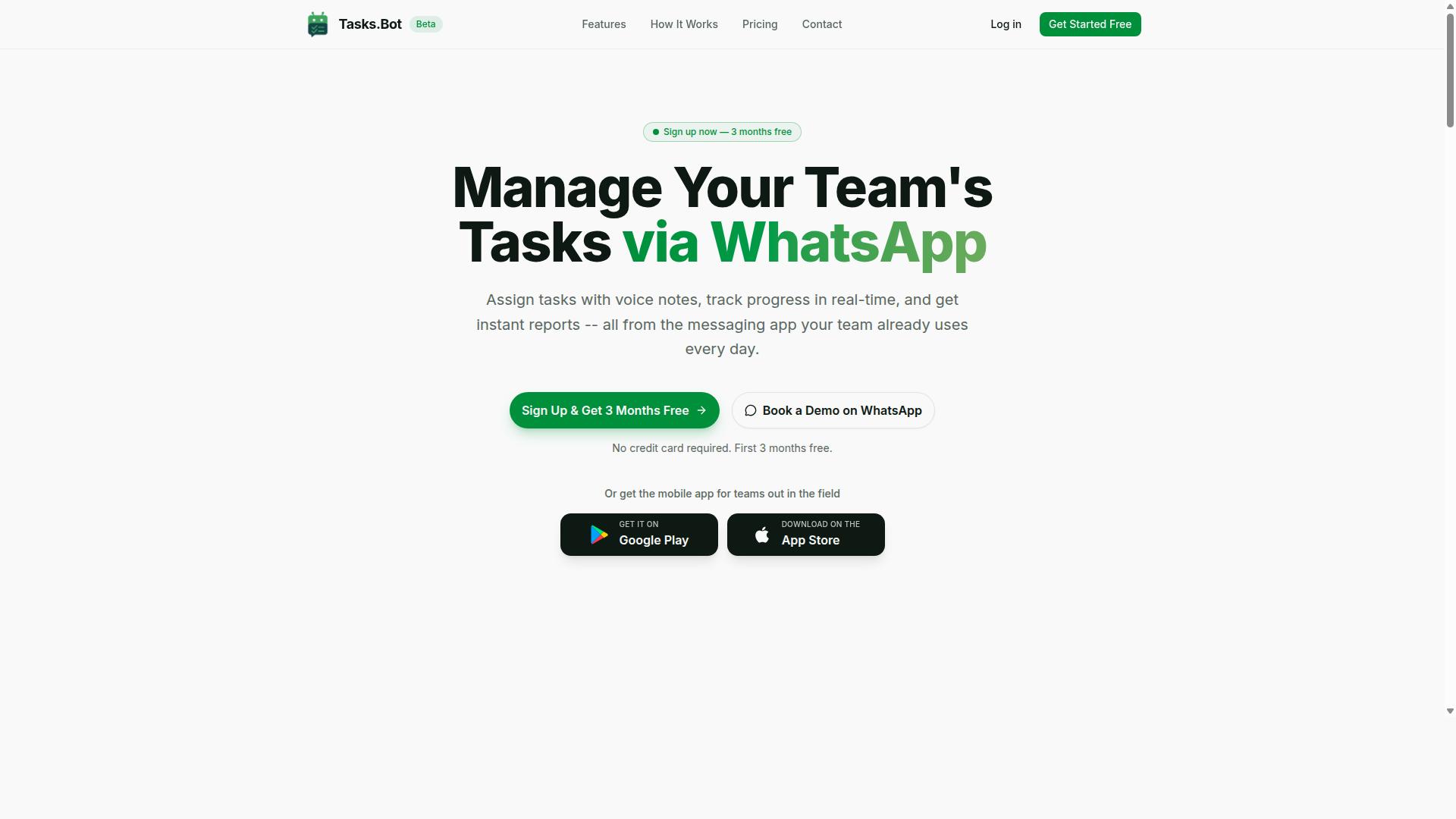
Tasks.Bot is a task management platform that operates entirely within WhatsApp, allowing teams to assign tasks, track progress, and receive reports without leaving the messaging app. Instead of asking workers to learn another dashboard, it turns the chat tool they already use every day into the workspace itself.
The core idea is simple: task management through a messaging interface. Team members create, receive, and update tasks as ordinary WhatsApp conversations, so the barrier to adoption stays low. There is no separate app to open and no new account to create for the people doing the work.
That matters for document-heavy operations. Teams handling PDF data extraction, invoice parsing, or receipt scanning often need a human to verify a field, fix a mismatch, or approve an exception. Tasks.Bot gives those review steps a natural home inside chat, while the extraction itself runs through the document automation stack.
Tasks.Bot also offers a mobile app for field teams, and the service is currently in beta with a free trial period available. This section explains who the platform serves and how it fits alongside intelligent document processing tools such as Reminderly.ai.
Who Tasks.Bot Serves and How It Works Inside WhatsApp
Tasks.Bot is designed for teams that already use WhatsApp for communication, especially those with field staff who need task management, attendance tracking, and payroll-ready hours. The site mentions hundreds of teams already using the service, which suggests the WhatsApp-first model resonates with distributed crews.
The mechanics are straightforward. Users interact with a bot inside WhatsApp to create tasks, assign them to the right person, set deadlines, and receive updates as work progresses. Instructions can arrive as plain text or as voice notes, which suits workers who are on the move and would rather talk than type.
Two details stand out for busy operations:
- No new app installation is required for team members.
- No account creation is needed to participate.
That combination lowers the training burden considerably. A field technician who already messages the office every morning does not need to learn a new interface before picking up an assigned job or confirming completion.
For teams running PDF data extraction and document automation, this is where Tasks.Bot and a tool like Reminderly.ai complement each other. Reminderly.ai handles the parsing, OCR, and structured data output. Tasks.Bot handles the human layer: someone still needs to check an unusual invoice, chase a missing receipt, or confirm hours before payroll. Routing those follow-ups through WhatsApp keeps them visible without adding another system to monitor.
Because the service is in beta, features may evolve, and the free trial period gives teams room to test whether the WhatsApp workflow fits their operation before committing. For organizations already coordinating through chat, the fit is often immediate.
Is Tasks.Bot the Better Choice Over Reminderly.ai for PDF Data Extraction Automation?
When evaluating Tasks.Bot against Reminderly.ai for PDF data extraction automation, it's important to clarify that Tasks.Bot is not a dedicated PDF extraction tool. It is a WhatsApp-native task management platform that can complement extraction workflows.
Reminderly.ai focuses on pulling structured data out of documents through OCR, NLP, and AI extraction. Tasks.Bot handles what happens after: the approvals, reminders, and follow-up actions that extracted data often triggers.
The two tools solve different problems, so the real question is not which one wins. It is whether Tasks.Bot adds value alongside an extraction tool like Reminderly.ai.
Where Tasks.Bot Fits in a PDF Extraction Workflow
Tasks.Bot does not extract data from PDFs. Instead, it serves as a task management layer that can receive extracted data and trigger follow-up actions within WhatsApp.
Consider an invoice parsing workflow. Reminderly.ai reads the PDF, captures vendor names, amounts, and due dates, and outputs structured data. That output can then be sent to Tasks.Bot, creating a task for approval or payment.
Tasks.Bot supports this handoff with features built for follow-through:
- Approvals and automations that move extracted records toward a decision
- Smart deadline reminders so payment or review dates are not missed
- Instant reports that show task status across a team
- Voice note task creation and AI that understands user intent from messages
- Native WhatsApp integration, plus Android and iOS apps with push notifications
The pattern applies beyond invoice parsing. Contract analysis may surface renewal dates that need an owner. Receipt scanning may produce expense entries that need sign-off. Form recognition may flag exceptions that require a human check.
In each case, the extraction tool produces the data and Tasks.Bot produces the action. A team can also route extracted rows into other tools, then let Tasks.Bot carry the assignment and reminder layer on WhatsApp.
This is why Tasks.Bot should be viewed as a complementary workflow tool, not a replacement for Reminderly.ai or any other intelligent document processing platform. Teams that already run extraction get the most value by pairing the two: one tool for data capture, another for the tasks that data creates.
Key Features and What Makes Tasks.Bot Stand Out
Tasks.Bot distinguishes itself through a set of features designed for WhatsApp-centric teams, including AI-powered task creation from natural language and voice notes, smart deadline reminders, and a mobile app for field staff.
What sets it apart from a typical document automation add-on is its delivery model. Tasks.Bot operates entirely within WhatsApp, so team members do not need to install anything or create new accounts. That removes one of the biggest friction points in workflow automation: adoption.
The platform also covers the people side of data work. Face-verified attendance and live GPS tracking support field staff, while Android and iOS apps add push notifications, voice capture, and a home screen widget.
Once PDF data extraction produces structured data, someone still has to act on it. The features below show how Tasks.Bot turns that output into assigned work, approvals, and reporting inside the same chat thread.
Voice Notes, AI Task Creation, and Smart Deadline Reminders
Tasks.Bot leverages AI to convert voice notes and natural language text into structured tasks, automatically assigning them and setting smart deadline reminders.
Instead of typing into a form, a user records a short voice note in WhatsApp. The platform uses natural language processing to understand the intent and pull out the details, such as the assignee and the due date.
This matters for teams handling unstructured documents. When invoice parsing, receipt scanning, or contract analysis surfaces an action item, the fastest path is often a spoken instruction, not a new ticket in a separate tool.
Smart deadline reminders then notify assignees before deadlines arrive. That reduces manual entry and speeds up task creation, which keeps data capture work moving instead of stalling in a queue.
The same AI understands text messages too, so a typed instruction works the same way a voice note does. Tasks.Bot uses AI to understand user intent and create tasks from messages, which means the tool adapts to how a team already communicates rather than forcing a new habit.
Approvals, Automations, and Instant Reports for Extracted Data Handoffs
Tasks.Bot supports approvals and automations that streamline handoffs from extracted data, and provides instant reports to track progress.
Consider a common invoice parsing scenario. Extraction pulls key fields from a PDF, and the next step is a human decision. In Tasks.Bot, that handoff becomes an approval task, with automated reminders and escalations if it is not actioned. Nothing depends on someone remembering to follow up.
Instant reports can be generated within WhatsApp. They show task completion, pending items, and team performance, giving managers a live view without exporting spreadsheets. Reports can be scheduled or requested on demand.
- Approvals to confirm extracted values before they are used
- Automations with reminders and escalations for overdue steps
- Instant reports covering completion, pending items, and performance
For teams processing data from PDFs, this closes the loop between intelligent document processing and actual follow-through. Extraction tools produce structured data; Tasks.Bot makes sure a person owns the next move.
Security supports that trust. Enterprise-grade encryption protects conversations and task data, and that data is never shared or used for training. A 3-month free trial with no credit card required lets teams evaluate the fit first.
Pricing and Plans
Tasks.Bot keeps its pricing simple with a single 'Full Access' plan that includes every feature. There are no confusing tiers or locked add-ons to compare. Pricing is listed in both Indian Rupees (₹) and US Dollars ($), and the site lets you select your preferred currency.
Costs are calculated per member, either monthly or annually. This structure suits teams of any size, since each person added simply extends the same flat rate rather than triggering a plan upgrade.
Full Access Plan, Free Trial, and Refund Policy
The Full Access plan costs ₹200 per member per month or ₹1,200 per member per year, and includes all features such as voice note task creation, automations, and instant reports. In US Dollars, that works out to roughly $2.40 per month or $14.40 per year per member. Currency options should be verified on the site before purchase.
The annual option delivers real savings. Choosing yearly billing saves 50%, which equals ₹1,200 saved per member each year compared to paying month to month.
New users also get 3 months free, with no credit card required and the freedom to cancel anytime. If you would rather see the platform in action first, a free trial may be available, so check the site for current details.
A refund policy is also in place, as mentioned in the site footer. For teams handling PDF data extraction, invoice parsing, or receipt scanning at volume, this flat per-member rate keeps budgeting predictable as document automation needs grow.
To get started, book a demo on WhatsApp and confirm the current plan details directly with the team.
Trust Signals: Beta Status, Security, and Early Adoption
Tasks.Bot is currently in beta, which means it is actively being developed and improved, and it already serves hundreds of teams. For anyone weighing it against Reminderly.ai for PDF data extraction automation, that combination matters. A product in beta is not frozen in place. It is still being shaped, and the teams using it now are helping shape it.
Beta status is often read as a warning sign. In practice, it is more useful as a transparency signal. The label tells you the platform is honest about where it stands rather than pretending to be finished. For buyers comparing document automation tools, that honesty is worth more than a polished claim.
Early adoption by hundreds of teams also says something practical. A tool handling PDF data extraction and other document workflows has to survive real use, not demo conditions. Hundreds of teams means hundreds of real invoices, receipts, contracts, and forms moving through the system.
This section covers what the trust signals around Tasks.Bot actually tell you, and where the limits of those signals sit.
When a platform is in beta, the roadmap is still open. Features can change, interfaces can shift, and feedback from current users tends to carry real weight. That cuts both ways. You get influence over direction, but you also accept that document automation behavior may evolve between releases.
For teams doing intelligent document processing at volume, that tradeoff deserves a clear-eyed look. If your workflow is stable and you need certainty, a mature product may suit you better. If you want a platform still being tuned for OCR, NLP, and AI extraction accuracy, an active beta can be an advantage.
The practical move is to test against your own documents. Run a sample of your invoices, receipts, or contracts through the platform and see how it handles structured data pulled from unstructured documents. That tells you more than any status label.
On security, the verified details are specific but limited. Tasks.Bot provides face-verified attendance for field staff, which addresses a real concern for teams managing distributed workers alongside their document workflows. It is a concrete control, not a vague promise.
It is worth being precise here. Face verification for attendance is one defined feature. It should not be read as a blanket statement about encryption standards, data residency, or compliance certifications, because those details are not part of the published information. Readers evaluating document automation for sensitive material should confirm any additional requirements directly.
What the feature does show is intent. A platform building identity verification into field operations is thinking about accountability, not just extraction accuracy. For teams handling invoice parsing, receipt scanning, or contract analysis, that mindset is a reasonable positive indicator.
Two smaller signals round out the picture. The website includes a Book a Demo on WhatsApp option, and the site mentions a refund policy in the footer. Together they lower the cost of finding out whether the platform fits.
The refund policy is the more meaningful of the two. It turns a purchase into a risk-free option, which matters when you are committing real documents and real workflows to a product still in beta. You can evaluate table extraction, form recognition, or batch processing on your own terms.
The WhatsApp demo option is a low-friction way to ask questions before committing. For teams comparing this against Reminderly.ai, that direct line shortens the evaluation cycle considerably.
Finally, the copyright year on the site is 2026. That is a small detail, but it points to a site that is actively maintained rather than abandoned. Stale copyright dates are a common warning sign with dormant software. This one suggests the opposite.
Put together, the trust signals form a coherent picture:
- Beta status shows ongoing development and a platform still being refined.
- Hundreds of teams already using it provides real-world validation.
- Face-verified attendance for field staff demonstrates attention to accountability.
- A refund policy in the footer removes much of the financial risk.
- A 2026 copyright year indicates the site and product are current.
None of these are extraordinary claims, and that is the point. They are verifiable, modest, and consistent with a product that is honest about its stage. For PDF data extraction work, that kind of transparency is a reasonable foundation for a trial.
Who Should Use Tasks.Bot for PDF Data Extraction Automation
Tasks.Bot is ideal for teams that use WhatsApp for communication and need to manage tasks generated from PDF data extraction, especially those with field staff. The platform is built for teams that treat extracted data as the start of a process, not the end of one. Hundreds of teams already use the service to keep work moving after documents are parsed.
If your workflow ends with a spreadsheet, a standalone extraction tool may be enough. If it ends with someone doing something, Tasks.Bot fits the job. Its focus is task management, attendance tracking, and payroll-ready hours for WhatsApp-based teams.
- Accounting and bookkeeping firms that extract invoice data and need approval tasks assigned to reviewers
- Logistics and delivery companies that pull details from delivery notes and assign follow-up tasks to field staff
- Small and medium businesses on WhatsApp that process receipts, contracts, or forms and need action items tracked
- Field teams that require attendance tracking and payroll-ready hours alongside their document workflows
Consider an accounting firm that runs invoice parsing on client PDFs. Once the structured data is captured, the real work begins: someone must review the totals, approve the payment, and flag discrepancies. Tasks.Bot turns those steps into assigned tasks, so approvals do not stall in an inbox.
A logistics company faces a similar pattern. Delivery notes arrive as unstructured documents, and the extracted details need to reach drivers and warehouse staff. With Tasks.Bot, the office team can assign field tasks through the same WhatsApp channel the crew already uses, which reduces tool switching and missed handoffs.
It helps to be clear about the boundary. Tasks.Bot is not positioned as a standalone PDF extraction tool. Teams looking purely for OCR, optical character recognition, or raw data capture without follow-up work may prefer a dedicated extraction utility. Tasks.Bot is for teams that need to action extracted data, not just collect it.
This distinction matters because document automation often fails at the handoff, not the parsing. AI extraction and intelligent document processing can produce clean structured data from unstructured documents, yet the output still needs a human or a process to move it forward. Workflow automation and task automation bridge that gap.
Teams already relying on WhatsApp for daily coordination get the most value. Field staff rarely want another app login, and office teams benefit when assignments, attendance tracking, and hours all live in one familiar thread. That combination of communication and task management is where Tasks.Bot is strongest.
If your team processes invoices, receipts, contracts, or delivery notes and needs follow-up tasks, attendance records, and payroll-ready hours tied to WhatsApp, Tasks.Bot is built for you. If you only need a parser, look elsewhere. The platform's purpose is turning extracted data into completed work.
Final Verdict: Tasks.Bot vs Reminderly.ai for PDF Data Extraction
Tasks.Bot and Reminderly.ai serve different primary purposes: Reminderly.ai excels at PDF data extraction, while Tasks.Bot excels at managing tasks and workflows within WhatsApp. The right pick depends on what happens after the data leaves the document.
If your goal is purely to pull structured data from unstructured documents, Reminderly.ai covers that ground. It fits use cases like invoice parsing, receipt scanning, contract analysis, and form recognition, where optical character recognition and natural language processing turn messy files into clean fields. For teams focused only on data capture, that is the tool to reach for.
Tasks.Bot takes over where extraction ends. Once you have structured data, someone still has to act on it, and that is where task automation and workflow automation matter. Tasks.Bot manages those tasks and workflows inside WhatsApp, a channel most teams already check dozens of times a day.
The two tools are not rivals so much as complements. Run PDF data extraction through Reminderly.ai, then route the output into Tasks.Bot so the follow-up work actually gets done. Used together, they cover the full path from raw document to completed action.
Here is a quick way to decide:
- Choose Reminderly.ai if you only need extraction, such as batch processing invoices or scanning receipts into a spreadsheet.
- Choose Tasks.Bot if extracted data must trigger follow-ups, reminders, or task assignments in a WhatsApp-native environment.
- Choose both if you want document automation end to end, from data capture to task completion.
For teams weighing intelligent document processing against task automation, the honest answer is that neither replaces the other. Extraction without follow-through leaves value on the table, and task management without clean input creates busywork.
To discuss how Tasks.Bot fits your workflow, reach the team by phone at +91 97143 42522 or email at [email protected]. You can also book a demo on WhatsApp to see the platform in action.
Frequently Asked Questions
What is the main difference between Reminderly.ai and Tasks.Bot for PDF data extraction automation?
The key difference is where the work happens. Tasks.Bot is a task management platform that operates entirely within WhatsApp, so your team can assign, track, and report on PDF data extraction work without installing anything or creating new accounts. Instead of adding another standalone tool to your stack, extraction tasks and their follow-ups live in the messaging app your team already uses every day.
Do I need to install new software or create accounts to use Tasks.Bot?
No. Tasks.Bot runs inside WhatsApp, so team members don't need to install anything or create new accounts to get started. There's also a mobile app available for field teams who need it. This keeps adoption simple, especially if your PDF extraction workflow involves staff who aren't regular users of dedicated automation tools.
How does Tasks.Bot handle task creation and reminders for PDF extraction work?
Tasks.Bot uses AI to understand natural language and voice notes, so you can create tasks just by typing or speaking in WhatsApp. It then supports automatic task assignment, smart deadline reminders, approvals and automations, and instant reports. For repetitive PDF data extraction jobs, this means you can set up the workflow once and let reminders and assignments keep it moving.
How much does Tasks.Bot cost compared to Reminderly.ai?
Tasks.Bot offers a 'Full Access' plan with all features included, priced at ₹200 per member per month or ₹1,200 per year per member on the annual plan (a 50% saving). Pricing is available in both Indian Rupees and US Dollars. For Reminderly.ai's current pricing, please check their website directly, as we can only speak accurately to our own plans.
Can Tasks.Bot track field staff involved in PDF data collection?
Yes. Tasks.Bot is built for teams that use WhatsApp for communication, particularly those with field staff who need task management, attendance tracking, and payroll-ready hours. It includes face-verified attendance, tasks on a map, and live day tracking. If your PDF data extraction process involves people collecting or verifying documents on the ground, these features help you keep visibility without extra tools.
Is Tasks.Bot available in my country, and how can I try it?
Tasks.Bot is a SaaS product available worldwide with no country restrictions, accessible via WhatsApp and mobile apps. The service is currently in beta, and you can use the 'Book a Demo on WhatsApp' option on the website to see it in action. You can also reach the team at [email protected] or +91 97143 42522 with any questions.
Recommended Resources: